

AXL vs Circle
Circle starts with community. AXL connects community to the full customer journey, with pricing, CRM, courses, webinars and automation in the same account. Every Circle figure here was read from circle.so/pricing.
Free plan, no card needed.
The short answer
AXL is the better fit when community has to drive sales, learning and follow-up. The difference: spaces, events and memberships stay connected to checkout, CRM, courses, webinars and automation.
Circle figures from circle.so/pricing and its MCP documentation. AXL from axl.tech/pricing.
Where AXL wins
No transaction fee, at any level.
Circle's cut is tied to the plan and never reaches zero: 2% on Professional, 1% on Business, 0.5% on custom-priced Circle Plus. The fee, not the plan, is what grows. At $200,000 a month in sales, Business's 1% is $2,000, ten times the plan.
Email starts inside the plan allowance.
Circle's own page prices Email Hub at $99 a month for 10,000 contacts, "charged on top of community plan". AXL runs email and chat as one campaign on the same segment.
Automation and the agent are not a $199 gate.
Professional caps workflows at 20 and has no API or MCP; both start at Business, where the agent is metered at 5,000 tool calls a month. AXL ships 139 node types and ~1,100 operations on every account.
Access rules that maintain themselves.
Circle's access groups are lists. AXL writes a space's permission as a CRM contact filter (has an active Studio Membership subscription) and it updates itself as people qualify and lapse.
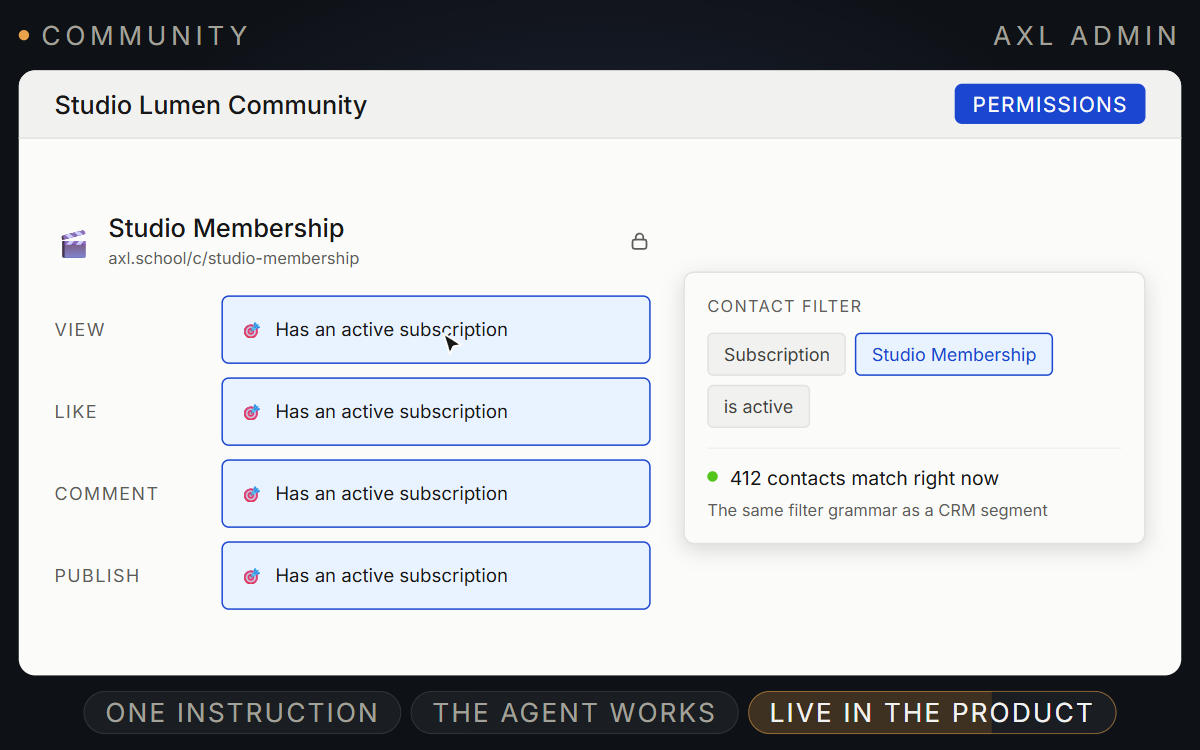
AXL uses the same CRM filter to control every community permission.
The plan is the small half of the bill
| Comparing | AXL | Circle |
|---|---|---|
| Entry plan | Start free, paid plans from $49/month, with included usage and published overage rates | $89 Professional: 20 spaces, 20 workflows, 2% fee, no API or MCP |
| The tier most people end on | Larger allowances when they lower the total | $199 Business: unlimited workflows, 1% fee, MCP from here at 5,000 tool calls a month |
| Email marketing | Included by plan, then $0.0006 each | Email Hub, +$99/month for 10,000 contacts, first 30 days free |
| Cut of your sales | 0% | 2% Professional · 1% Business · 0.5% Circle Plus · never 0% |
| At $5,000 a month in sales | $49 ($588 a year) | Professional $189 · Business $249 · Business with Email Hub $348 |
| At $200,000 a month in sales | $49, with no change as revenue grows | Business costs $2,199, of which $2,000 is the fee |
Reference business: 2,000 contacts, one course, 5,000 emails a month, own Stripe. AXL Starter is $49 for this reference business: model your own bill first.
The comparison table
| Capability | AXL | Circle |
|---|---|---|
| Agent access | Included; ~1,100 operations across the whole platform | A real MCP server from Business $199, metered at 5,000 tool calls a month; scope is community objects |
| Automation | 139 node types, 27 of them waiting listeners, on every account | 20 workflows on Professional; unlimited from $199 |
| Email marketing | Included allowance, then $0.0006 each | Email Hub add-on, +$99/month for 10,000 contacts |
| Courses, assessment and certificates | Six question types, a homework queue with voice feedback, a certificate designer with a registry, cohorts | Courses exist; reviewers report no advanced assessments and no completion certificates |
| CRM, funnels and payments | Kanban pipelines, checkout on your page, order bumps, upsells, 20+ providers | A community product with billing attached, on Stripe; its pages describe none of this |
| Space permissions | Written as CRM filters, so they update themselves | Access groups, maintained as lists |
| Community connected to revenue | Spaces, threads, webinars, events, gamification and permissions tied to the CRM record | A polished community workspace whose CRM, funnels and delivery live outside the core product |
"Reviewers report" means a third party's characterisation, not Circle's own words. If Circle ships something this table missed, tell us and we will date the correction.
What moves, and what to check first
- Members as contacts by CSV, matched on email.
- Spaces, courses and prices: rebuilt by the agent, so access groups become rules.
- Members and spaces in one to two days; courses in one to three.
- Post, comment and event history: archive it and keep the old space readable.
- Course progress.
- Saved cards for existing members.
Plan the member experience before the switch. If your current setup depends on a native branded app, keep that requirement separate. AXL serves the member area on your own domain in the browser. Plan the migration →
What people ask before they switch
Usually, and the gap widens with what you add and what you sell: Professional is $89 plus 2%, email is $99 on top, and unlimited automation plus the MCP server need Business at $199 plus 1%. The total is $348 a month for our reference business. At $200,000 in monthly sales the Business fee alone is $2,000. AXL Starter is $49 with all three included and no fee, though Circle does not state whether card processing sits inside its percentages.
Yes, a real one: an MCP server on its Admin API v2 that reads members, spaces, posts, events, courses, analytics and transcripts, and writes across most of them. Two limits matter: it needs the $199 Business plan, and it is metered at 5,000 tool calls a month. The full scoreboard.
AXL keeps community, revenue and operations on one customer record. Checkout, courses, webinars, CRM, messaging, video hosting and follow-up do not need connectors or duplicate profiles, and AXL takes 0% of sales. Choose it when the community is part of a larger product business.
Add up the fee, the add-on and the tier.
Import your members, rebuild one space with its access rule as a filter, send one campaign, then compare the whole bill, not the plan price.
Competitor pricing is verified against each vendor's own page. We re-check quarterly. Spot an error and we will fix it within a week.
Leaving Circle rather than choosing between two? Five Circle alternatives, compared
Also compare: AXL vs Kajabi · AXL vs Teachable · AXL vs Thinkific · AXL vs Kartra · AXL vs ClickFunnels · AXL vs GoHighLevel · AXL vs Skool · All comparisons