

Connect VS Code to AXL
One command from the palette, one paste, one browser sign-in, no key anywhere, and your editor's agent has tools over your CRM, sites, courses, automations and email.
1 · Add the server
Run “MCP: Add Server” from the command palette, choose HTTP, paste the URL, name the server axl, and pick Workspace or Global.
https://app.axl.tech/mcp
Workspace or Global? Workspace keeps the connection with one project, which is the safer default if you work across several accounts. Global connects everywhere you code.
Command and flow checked against Visual Studio Code's own documentation. It is somebody else's UI and it moves.
2 · Sign in
Your browser opens on an AXL consent screen. It names the client that asked and shows which account the agent will act as; if you administer more than one, switch there before approving. What the client receives is an ordinary admin access token scoped to that account, which is why the agent inherits your permissions rather than a separate set.
3 · Ask for something
“How many contacts do I have, and how many of them opened anything in the last month?”
A counting question is the cheapest way to confirm the connection is real before you ask it to build anything. What it can build →
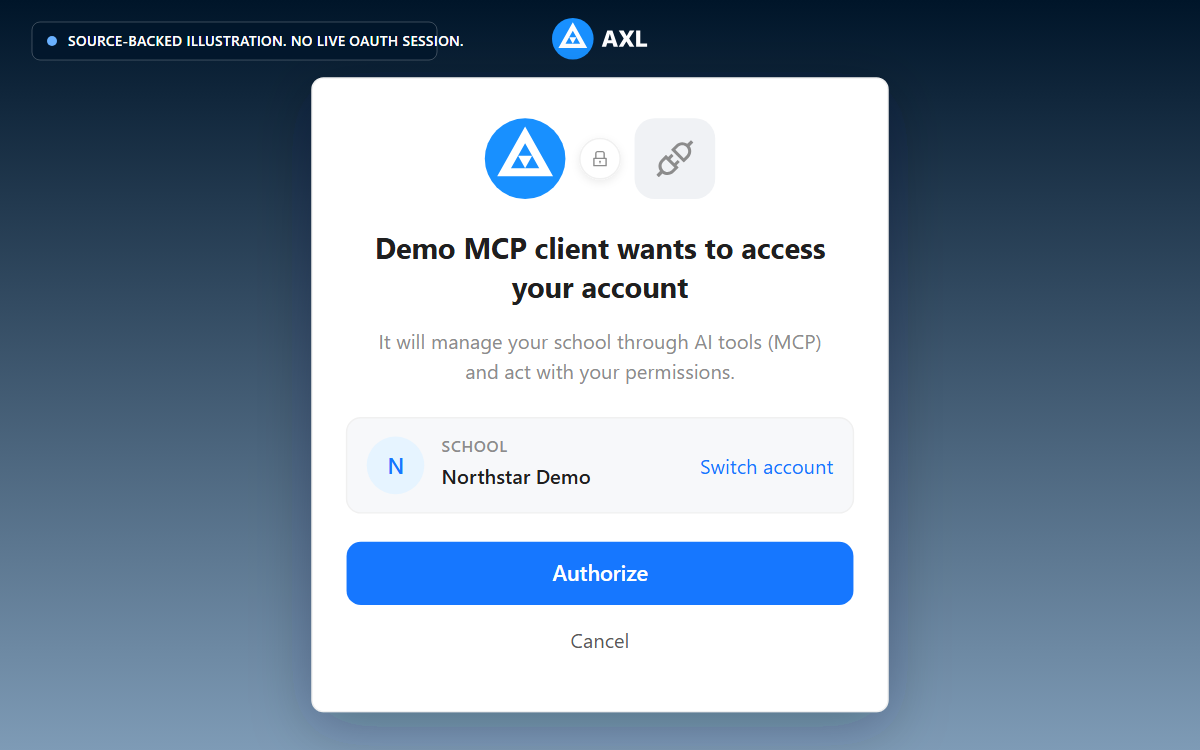
Review the school and access request before you approve the connection.
If it does not work
- •You see a 405. Expected if something tried a
GET: the server speaks JSON-RPC overPOSTonly. A client that insists on a GET stream must go throughmcp-remote. - •The browser never opened. The client registers itself first, and that step fails quietly if the URL is not exactly the endpoint. Re-check it, then remove and re-add the server.
- •Approval failed with “no school”. The token is scoped to an account and you have not created one yet. Finish that, then connect.
The agent acts as you, with your permissions, in one account. It writes without publishing (publishing and sending are separate steps you ask for), and 21 sensitive operations are not on its surface at all. What an agent can never do →